
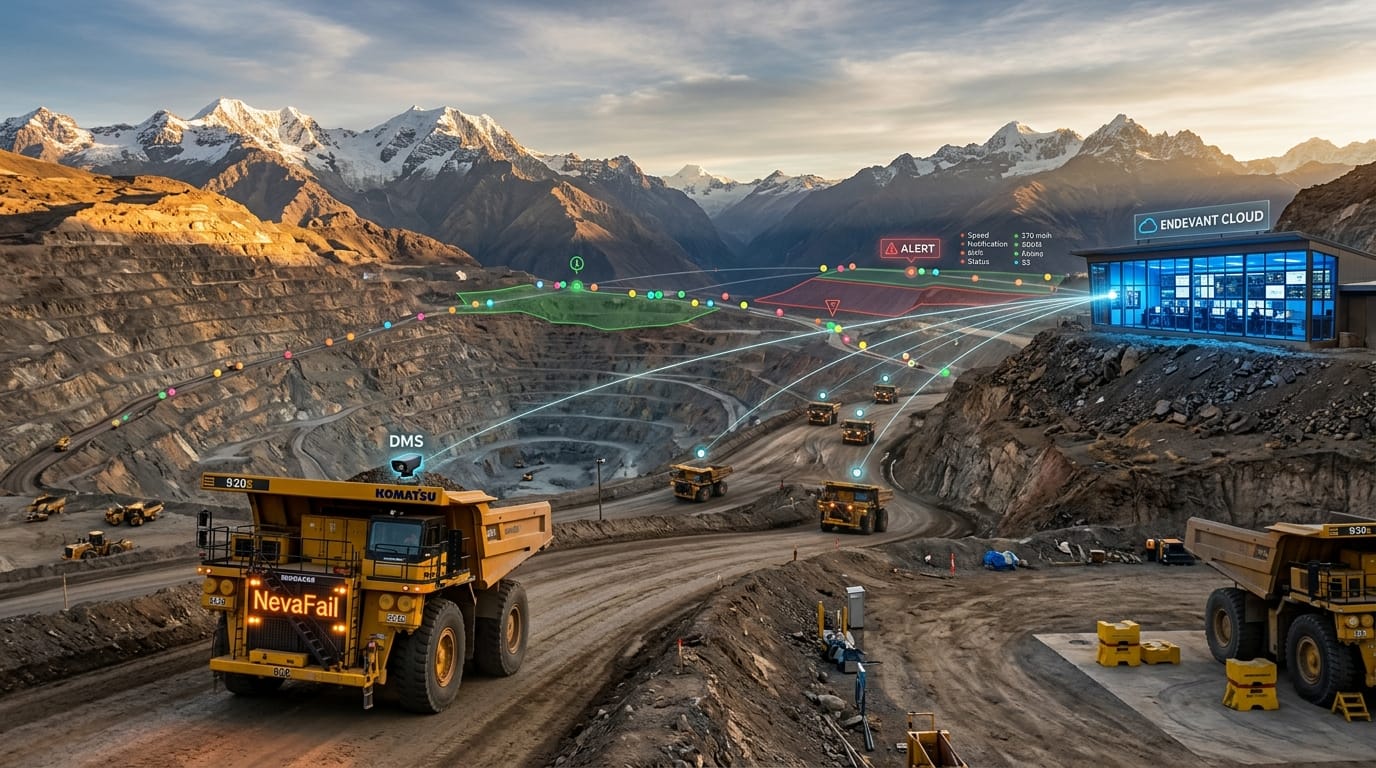
Operational safety in Peru's mining and transport sectors now rests on four technologies: AI cameras that detect fatigue and collision risk in the cab, GPS telematics, exclusion zones projected around heavy equipment, and certified cribbing that replaces timber in the workshop. Each one covers a different risk.
Both sectors share the same underlying hazards: fatigue and distraction behind the wheel, speeding, people working near mobile plant, and work under raised loads. Peru's Ministry of Energy and Mines (MINEM) publishes mining accident statistics and the WHO publishes road safety data; in both, many incidents keep repeating with the same causes.
What is operational safety?
Operational safety is managing the risks that come up in the day-to-day work of an operation: driving a truck at night, maneuvering a shovel near people on foot, or changing a component under a raised dump body. The goal is for control not to rely only on someone paying attention, but on barriers that still work when someone makes a mistake.
In Peruvian mining, the framework is the Occupational Health and Safety Regulation for Mining (Supreme Decree 024-2016-EM); in transport, MTC rules enforced by SUTRAN. Technology does not replace those management systems: it gives them data and physical barriers that did not exist before.
How do AI cameras detect driver fatigue and collision risk?
Endeavant DMS and ADAS cameras process video on board, inside the vehicle, and alert the driver in the cab immediately with voice, vibration and light. Because the analysis runs on the device, the alert does not depend on cellular signal: with no coverage, the video is stored with time and position and uploads when signal returns.
- DMS (driver monitoring system): tracks the face frame by frame and measures how long each gesture lasts: eyes closed, yawning, eyes off the road, phone in hand, smoking or a covered lens. At night it sees with infrared.
- ADAS (advanced driver assistance): the windshield camera watches the road and warns of forward collision risk and unsignaled lane departure, a common sign of drowsiness. Avant 5 and 8 add side cameras and blind-spot radar.
- 24/7 Control Center: every event reaches Endeavant Cloud with its video, and Endeavant operators validate it, talk to the cab if needed and notify the supervisor with the evidence.
Over time, reports show the routes, shifts and drivers with the most risk, and safety moves from investigating accidents to preventing them. How drowsiness is detected is covered in driver fatigue detection.
What does GPS telematics add to fleet safety?
Fleet GPS tracking with telematics turns driving into data: where each unit is, how fast it goes and how each driver drives. The Ituran GPS installed by Endeavant reports every 10 seconds over 4G and reads the engine via OBD / CAN Bus.
- Driver scoring: a 0 to 100 score based on 20 maneuver types detected by accelerometer, such as harsh braking, acceleration, speeding and cornering.
- Geofences: authorized and restricted zones with entry and exit alerts, and speed limits by zone and route.
- Real-time alerts: speeding, after-hours use and harsh braking, to your phone or email.
To choose a system, see our guide to fleet GPS tracking in Peru.
How do you protect people working around heavy equipment?
People working near mobile plant is one of the most serious risks on a mine site. Safety Halo™ from Incident Zero (Australia) uses laser or LED light to project an exclusion zone on the ground that moves with the machine, so operators and pedestrians can see how far to stay back, day or night. The Class 3R laser projects up to 50 m, for shovels, loaders and trucks; the LED marks an even zone around compact equipment. The whole system is IP68.
Equipment identification is the other half. NPR's NevaFail™ panels show each machine's number with high-brightness LEDs and a fail-safe ASTM D4956 retroreflective backing that keeps it legible even if power is lost, so operators, dispatch and supervisors work from the same visible reference.
Why replace timber cribbing in the mine workshop?
Timber used as support has no certified load rating, degrades with oil and moisture and can give way without warning. Polyurethane blocks from National Plastics & Rubber (NPR, Australia) come with a documented rated load:
- Stacko™: interlocking cribbing blocks that build towers up to 60 t and 150 cm, with load certified to AS1170.0 and a 3:1 safety factor.
- Timba™: high-density rigid polyurethane from 18 to 108 t per block, 30 kg/cm² to AS1170.0 and ASTM D1621-10.
- Tray Support: dump body support blocks for working under the raised tray of haul trucks, in 12 sizes for CAT, Komatsu, Hitachi, Terex and Liebherr.
How to choose between them is covered in support blocks for mining equipment maintenance, and the interlocking system in detail on Stacko™ cribbing blocks.
How do you safely immobilize mining equipment?
A parked machine is secured with wheel chocks. NPR's MineChock™ is a high-density polyurethane workshop chock with a handle and wheels: it is placed while standing, without bending down or reaching under the truck tire, which lowers the risk of back injuries and crush incidents. For the pit there are one-piece chocks in 10 sizes for tires from 400 to 4500 mm.
Why do safety technologies work better together?
No single technology solves operational safety on its own. A DMS camera detects fatigue but does not know the unit is speeding on a given route: GPS provides that. GPS knows where the unit is but cannot see whether the driver is distracted: DMS does. And neither protects the mechanic under a dump body: certified cribbing does.
The real step up comes when every risk has its barrier and someone responds to the alerts. In fleets, Endeavant cameras, GPS and the 24/7 Control Center cover the cab and the route; in the workshop and on site, NPR products and Safety Halo™ cover the work around and under heavy equipment.