
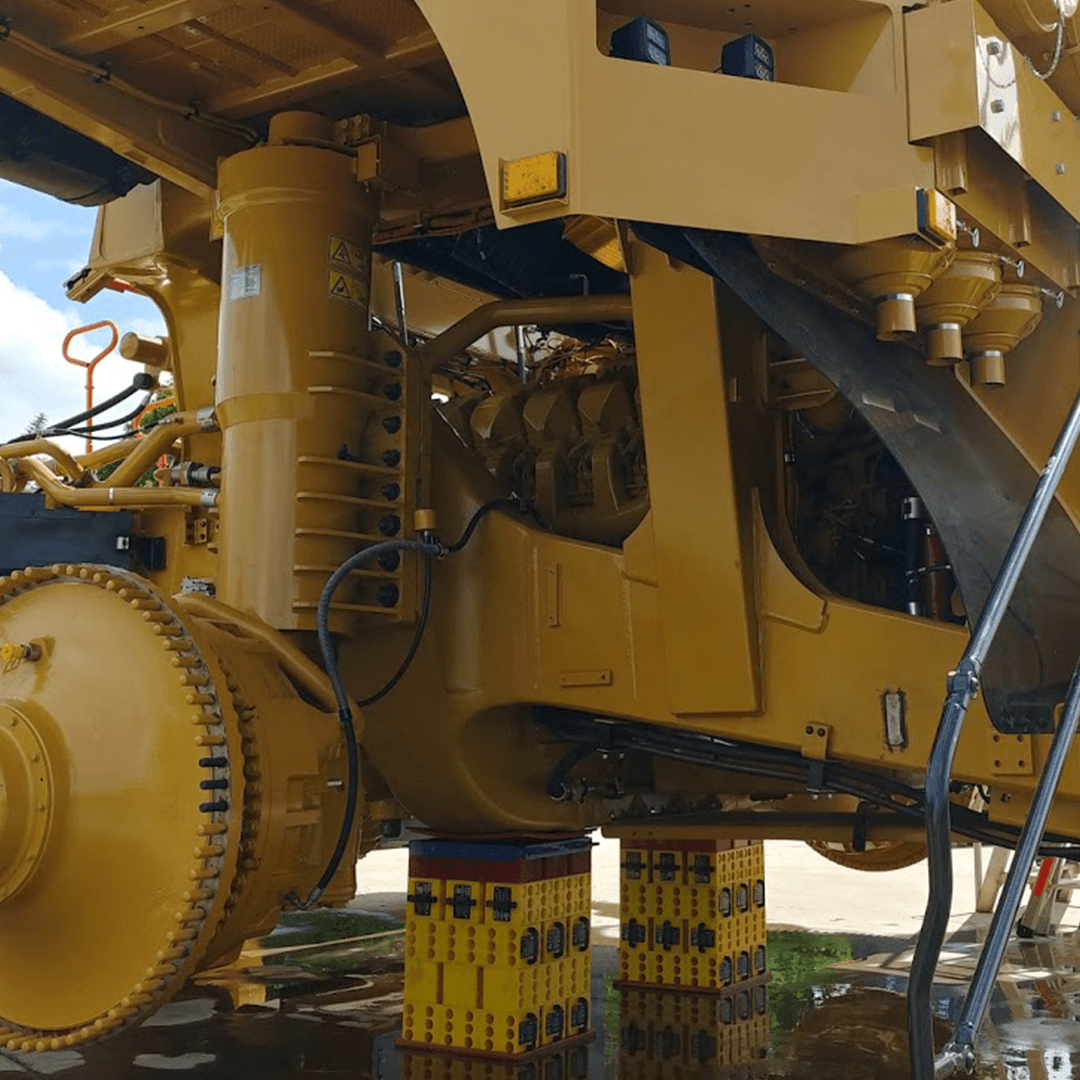
A cribbing block for mining equipment maintenance should have a load rating documented to a recognised standard (such as AS1170.0), a known safety factor, a tested temperature range, resistance to workshop fluids and a manageable weight. Timber meets none of those points; NPR's polyurethane Stacko™ and Timba™ blocks, rated at 30 kg/cm², meet all of them.
Why does the support block matter so much in mining maintenance?
Every time an engine, transmission, differential or axle comes off a haul truck, shovel or loader, someone works next to or under a component resting on blocks. If the support's capacity is unknown, that person's safety rests on a guess. That is why choosing the support system — Stacko™ interlocking cribbing towers, Timba™ blocks or Tray Support for haul truck trays — is a safety decision before it is a purchasing one. This guide sets out the technical criteria.
What technical criteria should a cribbing block meet?
When assessing support blocks for a mining workshop, these are the criteria worth asking for in writing:
- Documented load rating: the block's capacity should be tested to a recognised standard. The most common references are Australian standard AS1170.0:2002 (structural design actions) and ASTM D1621 (compressive properties of rigid cellular plastics).
- Known safety factor: a 3:1 factor means the published load is one third of what the block withstood in testing. Always ask whether the figure you are given already includes the factor.
- Tested in the way it is used: testing a loose block is not the same as testing a built tower. Stacko™, for instance, is tested as a single block and as a 150 cm tower.
- Tested temperature range: Peruvian sites run from the coast to the high Andes. Stacko™ and Timba™ keep their rating with the block between −50 °C and +40 °C; timber has no tested range.
- Fluid resistance: hydraulic oil, diesel, water and solvents should not change the block's weight or capacity.
- Weight and handling: a Stacko™ block weighs 8 kg against 12 kg for an equivalent recycled plastic block, and is up to 30% lighter than timber. When towers are built several times a day, that difference shows in the technician's back.
What is wrong with timber cribbing?
Timber is still used out of habit and availability, but it has technical limits that no procedure can fix.
Its strength varies with species, moisture content and grain orientation. A generic timber block cannot be given a repeatable, verifiable capacity: every time it is used, you are relying on an estimate, not on engineering data.
It also soaks up oil, fuel and water, rots, gains weight, splinters and cracks under repeated loading, and gets thrown out after a few uses. Nor does it have a test certificate backing its use as a temporary structural support, something mining sites' safety standards ask for more and more often.
Which certified cribbing blocks are available for mining?
National Plastics & Rubber (NPR), a manufacturer based in Brisbane, Australia, makes three families of support blocks for the mining workshop, all with capacity calculated from contact area:
- Stacko™: interlocking blocks in UV-stabilised virgin polyurethane (NPR05007-10, 510 × 150 × 150 mm, 8 kg). The standard triple tower holds up to 60 t and reaches 150 cm; the double, 46 t up to 60 cm; the single, 23 t up to 45 cm. Rated 30 kg/cm² with a 3:1 factor to AS1170.0 (2002).
- Timba™: single rigid polyurethane blocks that directly replace timber blocks. 30 kg/cm² to AS1170.0, compression verified to ASTM D1621-10. 100, 200 and 300 series, rated from 18 to 108 t by model, with 0% water and oil absorption.
- Tray Support: dedicated blocks for a raised haul truck tray, in 12 sizes (one per truck model, 11 to 34 kg), rated at 30 kg per cm² of rail contact.
Unlike recycled plastic blocks, of unknown composition and with up to 20% deflection under load, Stacko™ deflects less than 2% at full load.
Timber, recycled plastic or engineered polymer? Comparison
NPR's comparison guide sums up the differences between the three options:
- Safety factor: timber unknown | recycled plastic unknown | Stacko™ 3:1.
- Tested temperature range: timber unknown | recycled plastic +25 °C | Stacko™ −50 to +40 °C.
- Deflection at full load: timber unknown | recycled plastic up to 20% | Stacko™ under 2%.
- Material: timber variable by nature | recycled plastic of unknown composition | Stacko™ virgin raw material.
- Storage: timber indoor only | recycled plastic indoor only | Stacko™ outdoor or indoor (UV-stabilised).
- Tested as: timber not tested | recycled plastic single block only | Stacko™ block and 150 cm tower.
How do you calculate a cribbing block's capacity?
For Stacko™, Timba™ and Tray Support, capacity comes from bearing area: capacity = contact area (cm²) × 30 kg, with a 100 cm² minimum. With Timba™, for example, 400 cm² of bearing gives 12 t, 1,200 cm² gives 36 t and 3,600 cm² gives 108 t. The calculation assumes full, even contact, with no point loads or impacts, and always goes with your own risk assessment.
Which block should you use for each maintenance job?
- Heavy components at variable height: a Stacko™ triple tower, up to 60 t and 150 cm, with a top plate or top support.
- Round loads (axles, pipes, cylinders): Stacko™ with a V-block, for diameters from 15 to 120 cm.
- Linear or low-height supports: Timba™ 100 and 200 series blocks, stacked vertically or crossed.
- Raised haul truck tray: Tray Support, one size per truck model.
- Immobilising the truck in the workshop: MineChock™ wheel chocks, positioned standing up without reaching under the wheel.
For product detail, read our articles on replacing timber with Stacko™ and Timba™, Tray Support for haul truck trays and wheel chocks for mining equipment.
What should you consider when rolling out support blocks in Peru?
Peruvian mining operations work at altitude, with frost in the Andes and heat on the coast, and constant exposure to dust, water and fuels. Those conditions speed up timber's deterioration and call for a material with a tested temperature range.
Peru's mining health and safety regulation (Supreme Decree 024-2016-EM) requires every operator to have written standards and safe work procedures. A block with a documented rating lets you record each support's capacity before anyone works under the component.
In Peru, Endeavant S.A.C., based in Miraflores, Lima, distributes Stacko™, Timba™, Tray Support and MineChock™ wheel chocks, with advice on choosing the configuration for each machine and operation.
Cribbing block FAQ
What should I look for when choosing cribbing blocks for heavy equipment maintenance?
Ask for a load rating documented to a recognised standard such as AS1170.0, a known safety factor (for example 3:1), testing in the way the block is used (block and tower), a tested temperature range, resistance to oils and fuels, and a manageable weight. NPR's Stacko™ and Timba™ meet those criteria.
Why does AS1170 matter for mining cribbing blocks?
AS1170.0:2002 is the Australian and New Zealand standard for structural design actions. A block such as Stacko™ or Timba™ tested to AS1170.0 has a 30 kg/cm² rating that comes from a test and can be calculated and documented, instead of being guessed as with timber.
What are the best alternatives to timber cribbing in mining workshops?
NPR's polyurethane blocks: Stacko™, an interlocking system for towers up to 60 t and 150 cm with a 3:1 factor; Timba™, single blocks rated from 18 to 108 t; and Tray Support for raised trays. All are rated at 30 kg/cm² of contact, and Endeavant distributes them in Peru.
How do you calculate how much a cribbing block holds?
For Stacko™, Timba™ and Tray Support, capacity is the contact area in cm² multiplied by 30 kg, with a 100 cm² minimum. A Timba™ block with 1,200 cm² of bearing holds 36 t. The calculation assumes full, even contact and no point loads.