
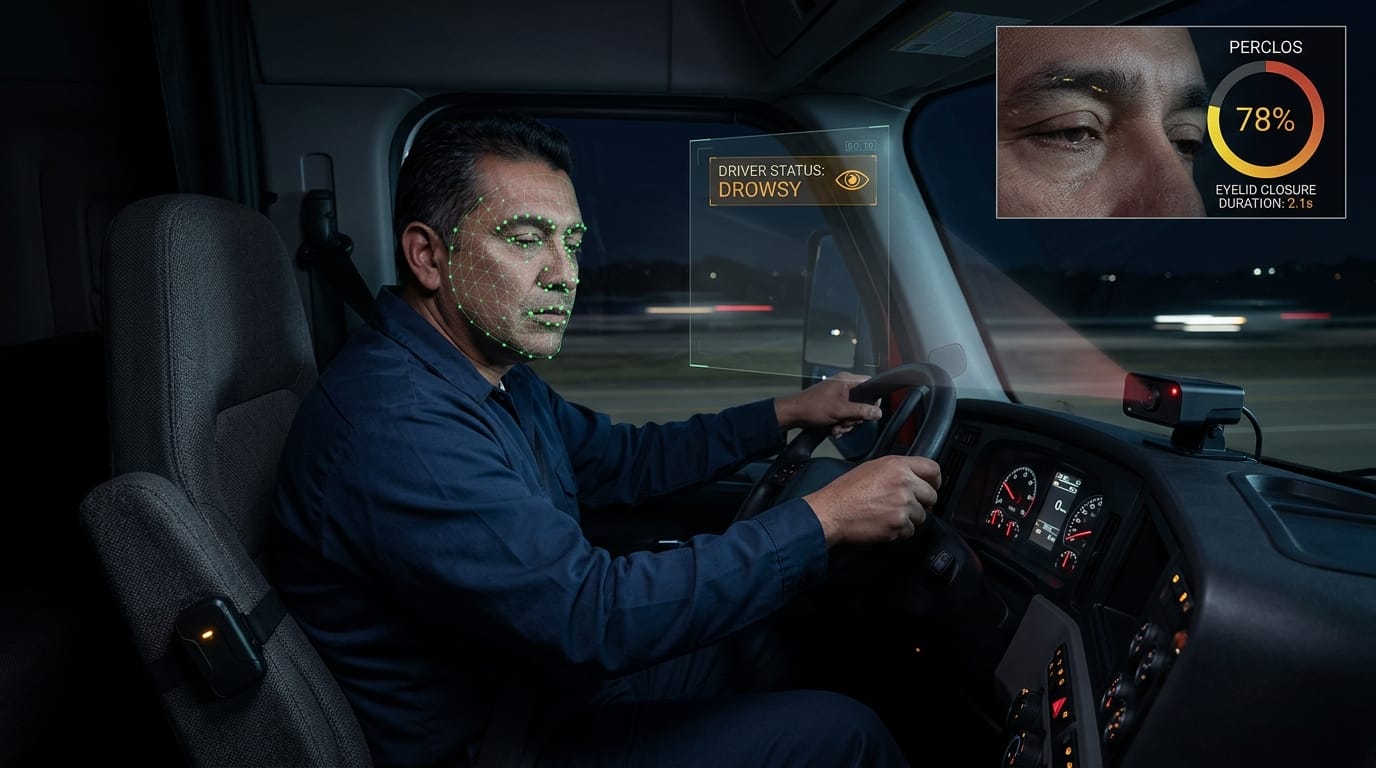
AI-based fatigue detection uses a DMS camera facing the driver that tracks the eyes, head nodding and yawning frame by frame. Once it confirms drowsiness, it alerts the cab with a voice warning and seat vibration. On Endeavant's Avant cameras, every event also uploads with its video to Endeavant Cloud, where the 24/7 Control Center validates it.
Why is drowsy driving a risk for fleets?
Fatigue slows attention and reaction time, and at its worst it causes microsleep: seconds in which the driver falls asleep with the vehicle moving. The World Health Organization records around 1.19 million road traffic deaths worldwide each year. In commercial transport the risk concentrates in long shifts, night driving and monotonous routes, which is exactly what mining haulage and freight transport in Peru look like.
For a fleet operator, every crash adds up to vehicle damage, downtime, legal exposure and losses that cannot be recovered. Preventing it means catching fatigue while it happens, not investigating it afterwards. That is the job of an anti-fatigue camera, while ADAS collision warning covers the road.
How does an AI-powered DMS camera work?
A driver monitoring system (DMS) is a camera with on-board AI that analyzes the driver's face and behavior in real time. Unlike systems that infer tiredness from how the vehicle is being driven, a DMS watches the person directly and measures how long each gesture lasts before classifying an event.
The DMS camera uses infrared illumination, so it sees the same by day, by night or in a dark cab. On Endeavant's Avant units the infrared light carries a photobiological certificate, so it does not harm the driver's eyes, and a shield dims the glare inside the cab.
Which indicators does a DMS use to measure fatigue?
Computer vision algorithms locate facial landmarks (eye contours, eyebrows, mouth and jawline) and track them frame by frame. From that geometry they work out whether the eyes are open or closed, whether the head is dropping or turning, and whether the mouth opens in a yawn.
The most studied indicator is PERCLOS (percentage of eyelid closure): the share of time, within an observation window, in which the eyelids cover at least 80% of the pupil. Research funded by the U.S. Federal Highway Administration (Dinges and Grace, 1998) validated it as a reliable measure of lost alertness. A high PERCLOS signals drowsiness even when the driver never fully closes their eyes.
Beyond PERCLOS, a DMS looks at blink rate and speed, head nodding and tilt, and yawning frequency. Combining several signals is what separates a normal blink from a microsleep.
What else does the DMS detect besides fatigue?
The DMS camera on Avant units detects seven risk behaviors:
- Fatigue and drowsiness: microsleep, closed eyes and head nodding. At 100 km/h, a 3-second microsleep means roughly 83 meters with nobody in control.
- Yawning: frequency and mouth opening, one of the earliest signs of tiredness.
- Phone use: phone in hand or at the ear while driving.
- Distraction: eyes off the road and a sustained head turn.
- Smoking: a lit cigarette in the cab, critical in vehicles hauling hazardous or flammable loads.
- Covered lens: lens obstruction is logged as an event, so covering the camera does not switch it off.
- Driver change: on the Avant 5 and Avant 8, the DMS PRO recognizes the driver by face.
What happens in the cab when the DMS detects fatigue?
The unit processes every frame on board without asking a server, so the alert does not depend on signal: it works the same underground, on high-altitude routes or in dead zones. The response is immediate: a voice warning, seat vibration from a 12 V or 24 V motor for when sound is not enough and, on the Avant 5 and 8, an alert light for noisy cabs.
At the same time the event uploads over 4G to Endeavant Cloud with 15 seconds of video before and 15 after. Endeavant's 24/7 Control Center reviews it, confirms whether it is real or a false positive, talks to the cab if the driver is still at risk and notifies the supervisor with the evidence. Without signal, the video stays in the unit's memory and uploads when coverage returns.
How does it integrate with a fleet management platform?
A single alert helps in that moment; the value for the operation shows up when events build up on a fleet management platform. On Endeavant Cloud every alert carries the shift driver, who checks in by scanning the vehicle's QR code, plus location and speed. That feeds the driver ranking, each driver's logbook and the hours and zones where events cluster. For DMS and ADAS side by side, see our guide to DMS and ADAS cameras for fleets.
With that data, training stops being generic: it targets the drivers, routes and shifts where fatigue concentrates, using each event's video as material.
What about driver privacy?
The DMS classifies behaviors (closed eyes, phone use, distraction) and each alert uploads with its video clip, which stays on the platform for 12 months. On the Avant 5 and Avant 8 the recorder also stores the full shift from every camera on the unit, and the DMS PRO recognizes the driver by face. Shift check-in by QR on Endeavant Cloud, by contrast, uses no biometric data: the driver registers their ID document.
In Peru, Personal Data Protection Law No. 29733 treats biometric data as sensitive. Good practice is to tell drivers what is recorded and why, and to define who sees what on the platform: Endeavant Cloud assigns per-module permissions to every user.
Which regulations require fatigue detection?
In the European Union, Regulation (EU) 2019/2144 has required driver drowsiness and attention warning (DDAW) on every newly registered vehicle since July 2024, and extends camera-based advanced driver distraction warning (ADDW) to all new vehicles from July 2026. Euro NCAP also scores driver monitoring in its ratings. Both are useful benchmarks for assessing an anti-fatigue system outside Europe too.
Which anti-fatigue camera should you choose?
The Avant 3 anti-fatigue camera has the DMS built in and is the simplest to install, for light and heavy transport. The Avant 5 adds DMS PRO with driver recognition, ADAS and blind spots for freight transport, and the Avant 8 covers the whole vehicle for mining. Installation takes two to three hours per vehicle.