
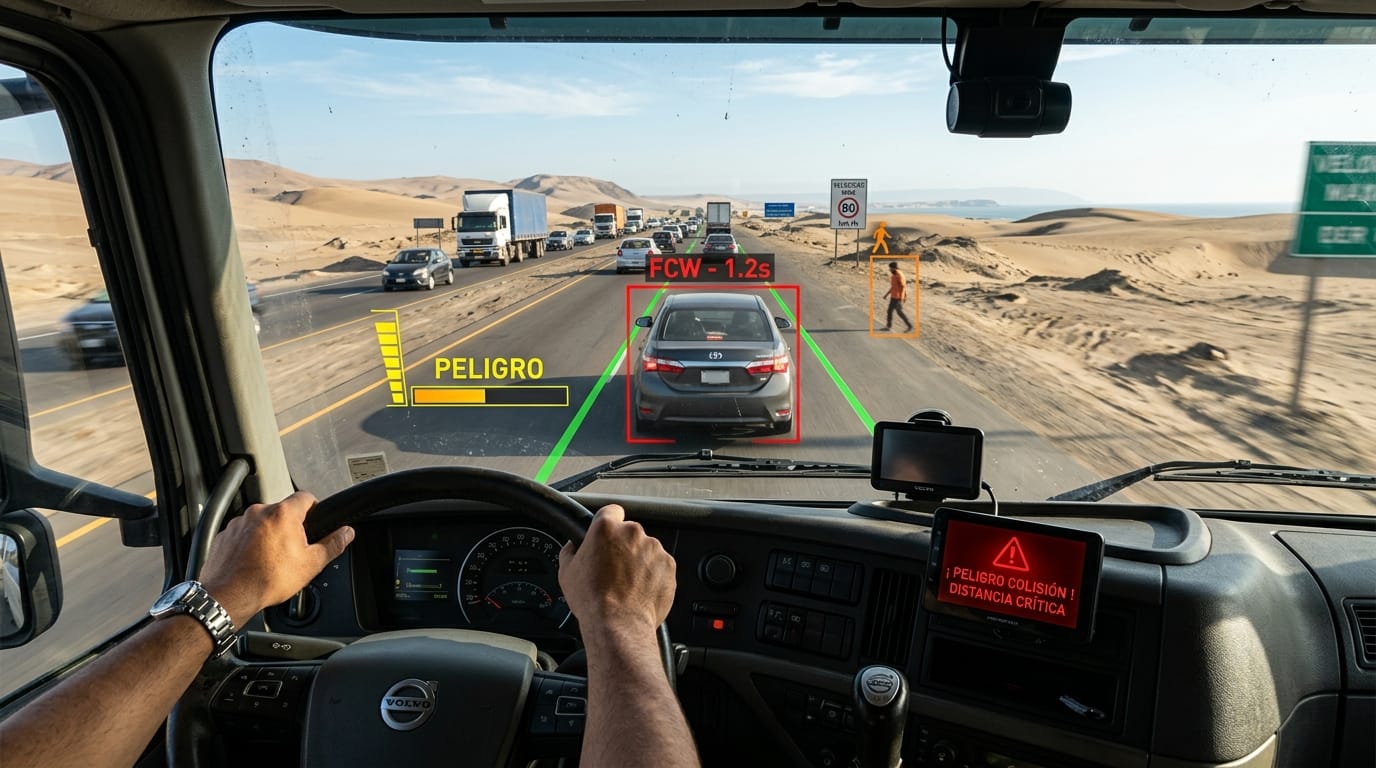
An ADAS system for commercial fleets is an AI-powered windshield camera that watches the road and warns the driver of forward collision risk (FCW), lane departure (LDW), short following distance (HMW) and pedestrians. On Endeavant smart cameras, the alert sounds in the cab and the 24/7 Control Center validates every event with its video.
Why does a commercial fleet need ADAS?
A truck or bus is heavier and needs more distance to stop than a car, so every second of warning counts. ADAS buys that time: it spots the risk before the driver would react on their own and flags it. The U.S. Insurance Institute for Highway Safety (IIHS) found that forward collision warning alone, with no automatic braking, cut front-to-rear crash rates by 27% in cars fitted with it from the factory (Cicchino, 2017).
ADAS watches the road; the driver is watched by the DMS, covered in driver fatigue detection. How both work together in one unit is explained in our guide to DMS and ADAS cameras for fleets.
What is ADAS and what does it include?
ADAS (advanced driver assistance systems) is the set of sensor-based systems, mainly cameras and radar, that read the vehicle's surroundings to detect risk. On a commercial fleet the core functions are:
- FCW, forward collision warning: detects the vehicle ahead and estimates time-to-collision (TTC) from the closing speed. When that time drops below the configured threshold, it warns the driver with time to react.
- LDW, lane departure warning: reads lane markings and warns when the vehicle crosses them without signaling, a common sign of drowsiness or distraction.
- HMW, headway monitoring warning: measures the gap to the vehicle ahead and warns when it is too short to stop in time at the current speed. It breaks the tailgating habit, a leading precursor of rear-end crashes.
- Pedestrian detection: identifies people in the frontal risk zone and warns when a collision is possible.
- BSD, blind spots: with side cameras and radar, warns when a person or vehicle enters the blind spot on either side. On Endeavant cameras it comes with the Avant 5 and Avant 8.
- Harsh driving: an accelerometer logs harsh acceleration, cornering and braking, which feed the driver ranking.
How does computer vision work in ADAS?
The core of an ADAS system is a forward-facing camera with on-board AI. Unlike a surveillance camera or a plain dashcam, which only record, an ADAS camera interprets what it sees in real time.
The process has four stages. First it captures the image, in Full HD 1080p on Avant units. Next, neural networks detect and classify vehicles, pedestrians, signs and lane lines. Then a monocular model estimates distance and relative speed from each object's apparent size and position in the frame. Finally, the system assesses the risk and decides whether to alert.
All of it runs on board, with no internet needed. That is why the in-cab alert is the same with or without signal; without coverage, the event video stays in the unit's memory and uploads when signal returns.
What does international regulation require for ADAS?
ADAS has moved from optional equipment to a legal requirement in several markets:
- European Union, Regulation (EU) 2019/2144: since July 2024 every newly registered vehicle must include, among others, intelligent speed assistance (ISA) and driver drowsiness and attention warning (DDAW). Trucks and buses must also carry a blind spot information system (BSIS) and a moving-off information system (MOIS), which protect pedestrians and cyclists next to the vehicle.
- Euro NCAP: Europe's safety rating program scores autonomous emergency braking (AEB), lane support and pedestrian and cyclist detection in its Safety Assist protocols.
- United States, FMVSS No. 127: NHTSA's final rule published in 2024 requires automatic emergency braking, including pedestrian AEB, on new light vehicles from September 2029.
- SAE J3016: SAE International's taxonomy places collision and lane warnings among assistance features that do not drive the vehicle: the driver stays in charge and the warning buys time to act.
What concrete benefits does ADAS bring to commercial fleets?
In a fleet, ADAS pays off on four fronts:
- Fewer rear-end crashes: according to IIHS, forward collision warning cut rear-end crash rates by 27%, and with automatic braking the reduction reached 50%. Fleet ADAS cameras are warning systems, so the first figure is the relevant one.
- Evidence for every event: on Endeavant Cloud each alert keeps 15 seconds of video before and 15 after, one MP4 per camera, plate, speed and time, stored for 12 months. That is the material for an investigation or a claim.
- Human validation: Endeavant's 24/7 Control Center confirms whether the alert is real or a false positive, talks to the cab if needed and notifies the supervisor. False positives do not count against the driver's ranking.
- Safety culture: in-cab alerts correct habits that become normal over time, such as tailgating or drifting over the line, and the ranking shows which drivers need coaching.
What do you gain by combining ADAS and DMS?
ADAS watches the road and DMS watches the driver. Together they explain the whole event: an unsignaled lane departure at the same moment the DMS sees closed eyes describes a drowsiness episode, not a deliberate maneuver. With both cameras on the same unit, the alert arrives with what each one saw in those seconds.
Brought into a fleet management platform such as Endeavant Cloud, events show on one screen with video, location and the shift driver, and feed the driver ranking and reports by route and shift. The 24/7 Control Center works on that same account.
Which Endeavant cameras include ADAS?
On the Avant 3 the ADAS camera is optional and joins the anti-fatigue camera for up to 3 cameras. The Avant 5 includes ADAS, BSD blind-spot radar, side and reverse cameras, an in-cab display and alert light, for freight transport. The Avant 8 adds three more channels, a 1 TB solid-state drive and MIL-STD-810H certification for mining. Installation takes two to three hours per vehicle, with Endeavant technicians in northern, central and southern Peru.