
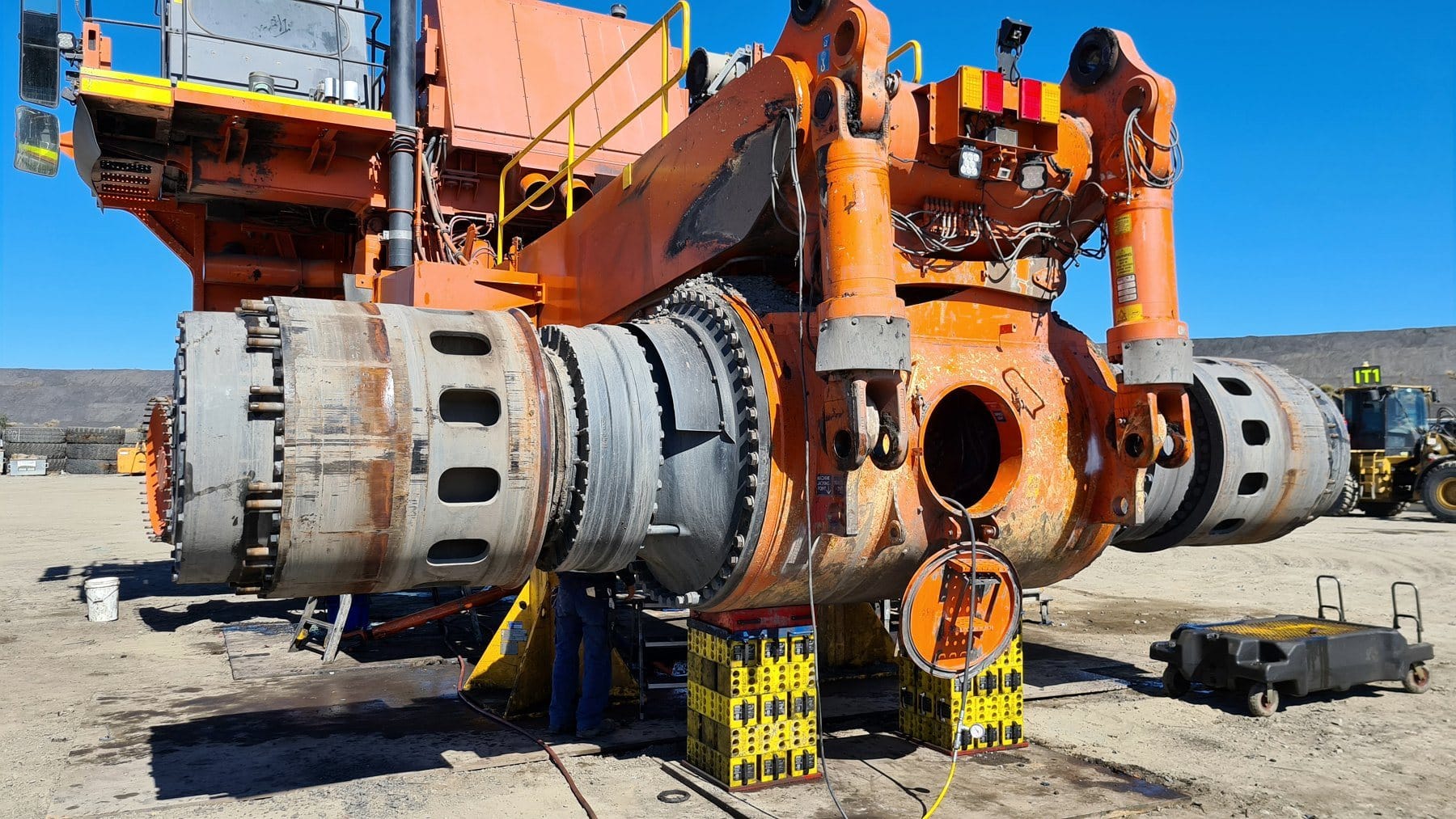
A timber block has no known load capacity; a Stacko™ block does: 30 kg/cm² with the 3:1 safety factor already applied, tested to AS1170.0 as a single block and as a 150 cm tower. The standard triple tower holds up to 60 tonnes. This comparison puts both supports side by side on load, weight, durability, fluids, inspection, stability and replacement.
Stacko™ is a system of UV-stabilised virgin polyurethane blocks that interlock layer by layer to build towers under haul trucks, shovels and components in maintenance. It is made by National Plastics & Rubber (NPR) in Brisbane, Australia, and supplied in Peru by Endeavant.
How much load does a timber block hold compared with a Stacko™ block?
For timber, nobody knows. Its strength varies with species, moisture content and grain direction, and there is no test behind it: every time it is used, you rely on an estimate. Stacko™ publishes its load and how to calculate it:
- Load rating: 30 kg/cm² of bearing area, with the 3:1 safety factor already included, over a 100 cm² minimum area.
- Calculation: capacity = bearing area in cm² × 30 kg. The supervisor calculates it and records it before anyone works underneath.
- Per tower: single (1 block per layer) 23 t up to 45 cm, double (2 blocks) 46 t up to 60 cm and standard triple (3 blocks) 60 t up to 150 cm.
- Deflection: under 2% at full load. Timber's is unknown.
- Temperature: load tested with the block between −50 °C and +40 °C. Timber has no tested range.
As a real example, Stacko™ towers held 29,597 kg under a CAT 785C haul truck.
How much does each weigh and how is it handled?
A Stacko™ block (NPR05007-10) measures 510 × 150 × 150 mm and weighs 8 kg, up to 30% less than timber. A timber block's weight varies: it depends on the species and how much water or oil it has absorbed. When towers are built several times a day, the difference shows in the technician's back. Timber also splinters, and splinters injure the hands that handle it; Stacko™ has no splinters.
What happens with oil, water and outdoor storage?
Timber soaks up water and oil: it rots, gains weight and breaks down with workshop fluids, and it can only be stored indoors. Stacko™ resists oil, workshop chemicals, salt water, rodents and insects, does not crack or rot and, being UV-stabilised, can be stored outdoors. Peruvian mine sites, with frost in the Andes, heat on the coast and dust, water and fuel all day, are exactly the conditions that break timber down.
How long does each one last?
Timber is a consumable: under repeated loading it cracks and deforms, and it is thrown out after a few uses and replaced again and again. A Stacko™ block is reusable: it does not absorb fluids or rot, and its rating stays the same as long as the part passes inspection.
How is a support inspected before loading?
Before building a Stacko™ tower, every part is checked for damage or anything that needs service, and a risk assessment is done. Because the part has a known load, inspection answers a concrete question: whether the block is fit to deliver its 30 kg/cm². With a timber block, inspection cannot confirm how much it holds, because it never had a tested capacity.
How stable is the stack?
In Stacko™ each layer locks into the one below. The standard tower is built on its mandatory base with 3 blocks per layer, each layer at right angles to the one below, up to 150 cm, and topped for the load with a top support, top plate, jack plate or V-block. NPR's rule is never to build the standard tower with 2 blocks per layer or a «bridging» layout; for 2 blocks there is the double tower with its own base.
To avoid working under suspended loads, the tower is built away from the equipment and rolled in with the NPR07829-00 safe positioning trolley, whose wheels retract under the load. Timber, by contrast, loses shape under repeated loading.
How do Stacko™ and timber compare point by point?
The same criteria, side by side:
| Criterion | Stacko™ | Timber block |
|---|---|---|
| Load rating | 30 kg/cm² with 3:1 factor | Unknown |
| Testing | AS1170.0, block and 150 cm tower | Not tested |
| Maximum tower | 60 t up to 150 cm (standard triple) | No data |
| Deflection at full load | Under 2% | Unknown |
| Tested temperature range | −50 to +40 °C | Unknown |
| Weight per piece | 8 kg | Variable |
| Water and oil | Not absorbed | Absorbed; rots and gains weight |
| Splinters | No | Yes |
| Storage | Outdoor or indoor (UV-stabilised) | Indoor only |
| Service life | Reusable | Thrown out after a few uses |
What drives the cost of each support over time?
The cost of a support is not just the part. Over time, four things weigh in:
- Replacement: timber is bought again and again because it is thrown out after a few uses; Stacko™ is reused.
- Lost material: timber that absorbed oil or rotted goes out of service; Stacko™ does not absorb fluids.
- Storage: timber needs covered space; Stacko™ can stay outdoors.
- Handling: 8 kg per block and no splinters mean less effort and fewer hand injuries when towers are built several times a shift.
When does Stacko™ fit, and when a single block?
Stacko™ is for variable-height towers with heavy loads, round loads from Ø15 to 120 cm with a V-block, or tight spaces with the single tower. If what you need is a piece that directly replaces a timber block in a linear or low-height support, there is Timba™, single rigid polyurethane blocks rated from 18 to 108 t. Both lines are compared in replacing timber with Stacko™ and Timba™, and the criteria for choosing a support in support blocks for mining equipment maintenance.
Stacko™ vs timber cribbing FAQ
Why replace timber cribbing with Stacko™?
Because a timber block has no known load capacity, splinters, absorbs water and oil and is thrown out after a few uses. Stacko™ is rated at 30 kg/cm² with a 3:1 safety factor tested to AS1170.0, weighs 8 kg per block, does not splinter or rot and is reused.
How much load does a Stacko™ tower hold?
The standard triple Stacko™ tower, with 3 blocks per layer, holds up to 60 tonnes and reaches 150 cm. The double tower holds 46 t up to 60 cm and the single tower 23 t up to 45 cm. A support's capacity is calculated as area in cm² × 30 kg.
Is Stacko™ lighter than timber?
Yes. Each Stacko™ block measures 510 × 150 × 150 mm and weighs 8 kg, up to 30% less than timber. It also does not absorb water or oil, so it does not gain weight with workshop use.
Can Stacko™ be stored outdoors?
Yes. Stacko™ is made of UV-stabilised virgin polyurethane and resists oil, workshop chemicals, salt water, rodents and insects, so it can be stored outdoors. Timber is stored indoors only because it absorbs water and rots.