
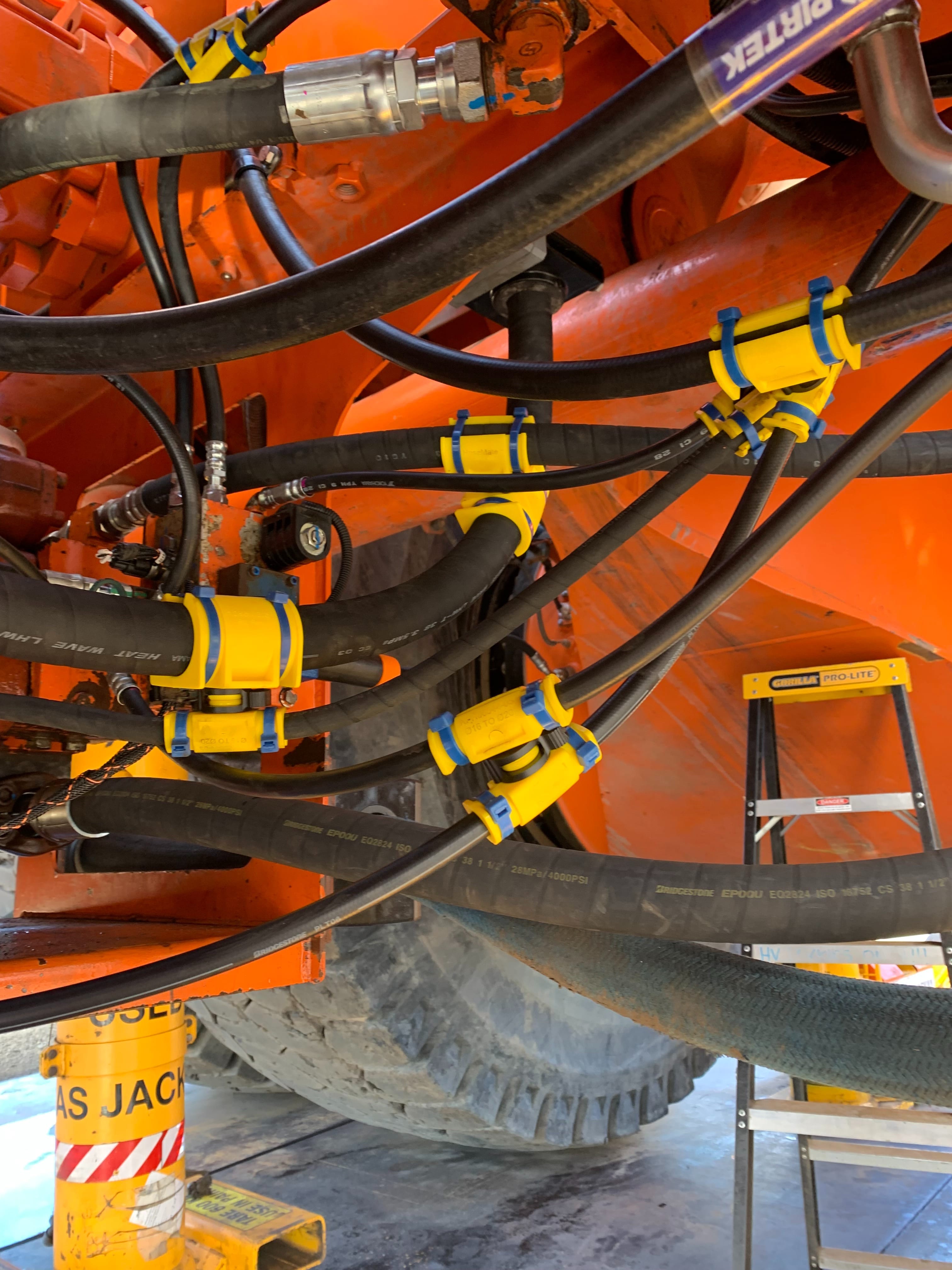
The most direct way to protect the hydraulic hoses on a mining machine is to stop external abrasion with hose separators, which hold every hose on its route and clear of the others and of the machine's surfaces. According to National Plastics & Rubber (NPR), the Australian maker of HoseMate™, hose failures are the third most common cause of mobile plant breakdowns, and most of them come from that abrasion.
Why do hydraulic hoses fail on mining equipment?
Most hydraulic hose failures on mobile plant start with external abrasion: hose rubbing on hose, and hose rubbing on a surface. With machine vibration, two hoses in contact wear each other down until the cover goes through, and the same happens against a sharp edge, a flat frame surface or a moving part.
Other causes add to abrasion: repeated flexing at articulation points, routing with too tight a bend radius or a twisted hose, and temperature cycling. SAE J1273, the recommended practice for hydraulic hose assemblies, covers exactly this: routing and abrasion protection. In every case, prevention starts with fixing each hose's route and keeping it from touching anything.
What happens when a hydraulic hose bursts in operation?
A hydraulic hose that bursts in operation stops the machine unplanned, wherever it happens to be: a ramp, a loading face, the pit floor. On top of the repair comes getting the maintenance crew and the spare part there. Spilled oil needs containment and clean-up, with the environmental risk that carries. High-pressure fluid escaping from a ruptured hose can also cause serious injection injuries to anyone nearby, and contamination entering the circuit speeds up wear on pumps, valves and cylinders.
What is a hose separator and how does it work?
A hose separator is a clamp that holds two or more hoses at a fixed distance from each other and from the machine. NPR's HoseMate™ hydraulic hose separators (Brisbane, Australia) are made from a V2 fire-rated, UV-resistant thermopolymer. They protect against sharp edges, hose-to-hose contact, flat surfaces and moving parts; they hold hoses of different widths and let each hose rotate 360° without compromising flexibility or performance.
The difference from a standard P-clip or cable tie is that a tie fixes a hose to a point but does not separate it from its neighbours. HoseMate™ goes on without special tools, without major work on the machine and without adding unnecessary weight. It was Highly Commended in the Innovation category at the 2023 Queensland Mining Industry Health & Safety Conference.
Which HoseMate™ size do I need?
HoseMate™ size is chosen by the hose's actual outside diameter. Don't work it out from the inside diameter: wall thickness varies by application. There are 11 sizes from 13 to 100 mm, each sold single or in a 10-pack:
| Hose OD | HoseMate™ single | 10-pack |
|---|---|---|
| 13–16 mm | NPR06644-02 | NPR16644-02 |
| 16–20 mm | NPR06644-03 | NPR16644-03 |
| 20–24 mm | NPR06644-04 | NPR16644-04 |
| 24–29 mm | NPR06644-05 | NPR16644-05 |
| 29–35 mm | NPR06644-06 | NPR16644-06 |
| 35–42 mm | NPR06644-07 | NPR16644-07 |
| 42–51 mm | NPR06644-08 | NPR16644-08 |
| 51–61 mm | NPR06644-09 | NPR16644-09 |
| 61–72 mm | NPR06644-10 | NPR16644-10 |
| 72–86 mm | NPR06644-11 | NPR16644-11 |
| 86–100 mm | NPR06644-12 | NPR16644-12 |
How do you install HoseMate™?
One assembly takes 2 HoseMate™, 1 joiner (NPR06644-01), Multigrip pliers (NPR07937-00), 4 tension straps and the strap cutter (NPR07939-00). Installation takes six steps:
- Measure the hose outside diameter in mm.
- Pick the HoseMate™ size that covers that diameter.
- Fit the HoseMate™ by hooking each hose into the separator body.
- Join both ends of the assembly in the joiner and close it fully with the Multigrip pliers.
- Secure each HoseMate™ with 2 tension straps: firm, not over-tight.
- Trim the excess strap with the cutter as you go.
Tension straps come in packs of 100: NPR17910-00 for sizes -02 to -06 and NPR17911-00 for sizes -07 to -10.
How was HoseMate™ tested?
NPR put HoseMate™ through a test regime designed to replicate the harshest operating environments:
- Vibration: 900 cycles per minute, sustained for 6.8 million cycles.
- Chemicals and fluids: immersed for 5 days at room temperature in hydraulic oil, engine oil, coolant, truck wash and degreaser.
- Cold: immersed in ice at −35 °C for 4 hours, under load.
- Heat: 1 hour in an oven at 90 °C, under load. V2 fire rating.
- Tension straps: V2 rated, heat- and UV-stabilised.
How long does a HoseMate™ separator last?
In most cases HoseMate™ outlasts the hose it protects and can be reused on the next job. At end of life the thermopolymer can be shredded into recycled products. The operational payoff follows from that: fewer hose failures and bursts, lower maintenance cost and less planned and unplanned downtime, higher machine availability, and fewer oil spills and clean-ups.
Where can you buy hose separators in Peru?
Endeavant S.A.C., in Miraflores, Lima, distributes National Plastics & Rubber products in Peru, with all 11 HoseMate™ sizes and the installation accessories. Tell us the machine and your hose diameters and we will quote sizes and accessories. For the maintenance workshop we also supply mining workshop products and cribbing blocks for heavy equipment maintenance; the full range is in the NPR catalogue.
FAQ
What is the main cause of hydraulic hose failure on mining equipment?
According to National Plastics & Rubber, hose failures are the third most common cause of mobile plant breakdowns, and most come from external abrasion: hose on hose and hose on surface. HoseMate™ hose separators remove that contact.
What are HoseMate™ separators made of?
HoseMate™ hose separators are made from a V2 fire-rated, UV-resistant thermopolymer. The tension straps that secure them are also V2 rated and heat- and UV-stabilised.
How do I choose the right HoseMate™ size?
Measure the hose's actual outside diameter and pick the size that covers it: there are 11, from 13–16 mm (NPR06644-02) to 86–100 mm (NPR06644-12). Don't work it out from the inside diameter, because wall thickness varies by application.
Do you need special tools to install HoseMate™?
No. A HoseMate™ assembly uses 2 separators, 1 joiner NPR06644-01, 4 tension straps, Multigrip pliers NPR07937-00 and strap cutter NPR07939-00. It goes on without major work on the machine.
Who distributes HoseMate™ in Peru?
Endeavant S.A.C., in Lima, distributes National Plastics & Rubber (Brisbane, Australia) products in Peru, including all 11 HoseMate™ hose separator sizes and their installation accessories.