
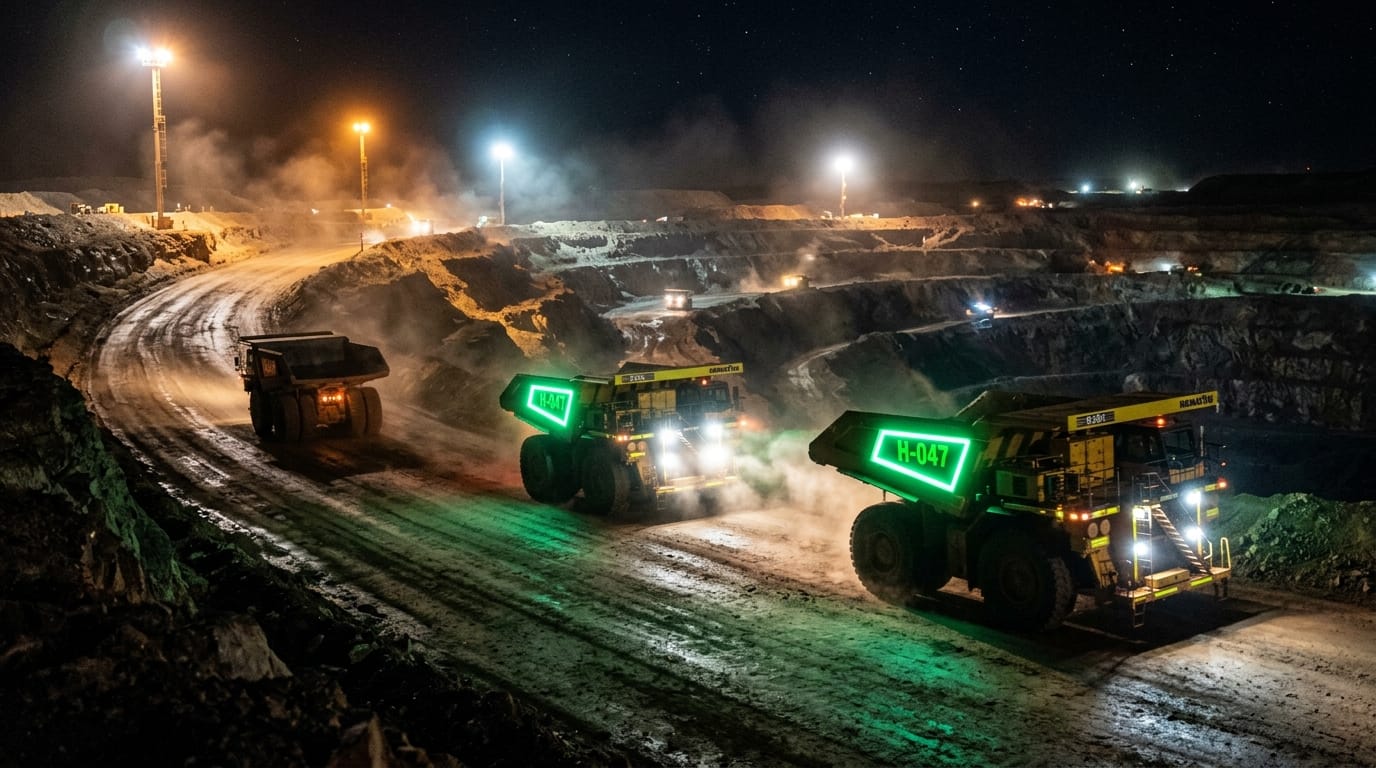
Good mining vehicle identification lets anyone read a machine's fleet number from a distance, day and night, in dust and even when power fails, for the whole life of the machine. It comes down to three decisions: digit height for the machine size, a mounting point where dispatch and traffic control can see it, and a technology that does not rely on a single light source.
Why does vehicle identification matter so much on a mine site?
An open pit runs haul trucks, shovels, loaders, dozers, water carts and light vehicles at the same time. Every radio call, every dispatch assignment and every right-of-way decision at an intersection starts with knowing which machine is which. When fleet numbers can't be read, the operation runs on guesswork: more delays, more operator-supervisor mix-ups and harder incident investigations.
In Peru, mine safety is governed by the Mining Occupational Health and Safety Regulation (D.S. 024-2016-EM), and each operation sets out in its internal traffic standards how equipment is identified. The practical question is not whether to identify machines but which method keeps the number readable in real pit conditions.
What are the options for mining vehicle identification?
There are four ways to display a fleet number, and each one depends on something different to be readable:
- Painted numbers: the simplest option. It needs a clean, intact surface and at night it only reads under external light. Renumbering means repainting.
- Retroreflective decals or signs: bounce headlight back to the viewer. ASTM D4956 classifies this sheeting, the same used on road signs. It still depends on an outside light source.
- LED panel: emits its own light and reads at night without external lighting. If power is cut, an LED-only panel goes dark.
- LED panel with fail-safe reflective backing: combines both: the LED reads at night and, if power fails, the reflective backing keeps the number readable under headlights. This is how NevaFail™ panels work.
Reflective or LED signage for mining vehicles?
Reflective and LED fleet numbers are best compared by what happens in each operating condition:
| Condition | Paint | Reflective | LED + reflective |
|---|---|---|---|
| Night, no external light | Unreadable | Unreadable | Readable (own light) |
| Under headlights | Low contrast | Readable | Readable |
| Power loss | N/A | N/A | Readable (reflective backing) |
| Renumbering | Repaint | New sign | Swap blanks* |
* On interchangeable NevaFail™ models. The takeaway: reflective sheeting is a good backup, but as the only layer it depends on someone lighting the number; LED covers the night shift and the reflective backing covers electrical failure.
What digit height should each machine use?
Digit height depends on machine size and the distance the number needs to be read from. As a reference, National Plastics & Rubber (NPR), the Australian maker of NevaFail™, recommends:
| Digit height | Recommended application |
|---|---|
| 300 mm | Mobile plant under 120 t |
| 400 mm | Mobile plant 120 t and over |
| 600 mm | Front of water carts and haul trucks |
Where should fleet numbers be mounted on the machine?
Mount the ID where the people making decisions about that machine can see it: the operator approaching head-on, the intersection controller, dispatch from its vantage point. On haul trucks and water carts, NPR reserves the 600 mm digit for the front of the machine. When a machine is approached from several directions, a triangle panel reads from more than one angle.
The mounting has to survive operation too: bolt-on or magnetic base depending on the model, a handrail bracket where there is no flat surface, and wiring routed away from areas where it can be damaged.
What does a fleet ID need to last on a mine site?
A mining vehicle ID that lasts on site meets four conditions:
- Sealed against the environment: the IP code (IEC 60529) states the protection. IP68 means dust-tight and protected against continuous immersion, which covers pit dust, rain and washdown.
- Impact- and vibration-proof body: a one-piece panel, for example in 95A polyurethane, has no joints for vibration to loosen.
- Matching power supply: 24 V is the standard electrical system on mining machinery; a 24 V panel connects without converters.
- Changeable number: machines get reassigned and fleets get renumbered. Interchangeable digits avoid buying a new panel for every change.
What is NevaFail™ and how does it apply these practices?
NevaFail™ is the LED ID panel from National Plastics & Rubber (Brisbane, Australia) for haul trucks, water carts and mobile plant. It combines high-brightness LEDs with an ASTM D4956 fail-safe retroreflective backing, is IP68 rated against water, dust and oil, runs on 24 V and has a 95A polyurethane body. It comes in flat, triangle or square formats with 300, 400 or 600 mm digits, interchangeable or custom, and meets the BMA identification specification.
For formats, part numbers and configurations, read our article on NevaFail™ LED ID panels.
How does identification fit with other traffic controls?
Identification answers "which machine is it". Other controls cover the rest of the traffic risk: the Safety Halo™ laser exclusion zone marks the danger perimeter on the ground around the machine, and on light vehicles and crew buses DMS and ADAS smart cameras alert the driver in the cab to fatigue, distraction or collision risk. Together they are independent layers: if one fails, the others still work.
Endeavant S.A.C., in Lima, distributes NPR products in Peru and helps each fleet choose format, mounting and numbering.
FAQ
What is the difference between reflective and LED signage on mining vehicles?
Reflective signage is passive: it only reads when an external light source, such as another machine's headlights, hits it. LED is active: it emits its own light and reads at night without external lighting. An LED panel with fail-safe reflective backing, such as NevaFail™, also stays readable if power is lost.
What digit height does a haul truck need?
As a reference, NPR recommends 600 mm digits for the front of haul trucks and water carts, 400 mm for mobile plant of 120 t and over, and 300 mm for mobile plant under 120 t.
What does IP68 mean on an ID panel?
IP68 is a protection rating under IEC 60529: the 6 means dust-tight and the 8 means protected against continuous immersion in water. On a mine site it means the panel handles fine dust, rain and pressure washing.
Which standard covers reflective ID sheeting?
ASTM D4956 is ASTM International's specification for retroreflective sheeting for traffic control, the same used on road signs. NevaFail™ panels use a reflective backing certified to that standard as their fail-safe layer.
Who supplies LED mining vehicle ID panels in Peru?
Endeavant S.A.C., based in Miraflores, Lima, distributes National Plastics & Rubber (Australia) NevaFail™ panels in Peru and helps choose format, digit height and mounting for each machine.