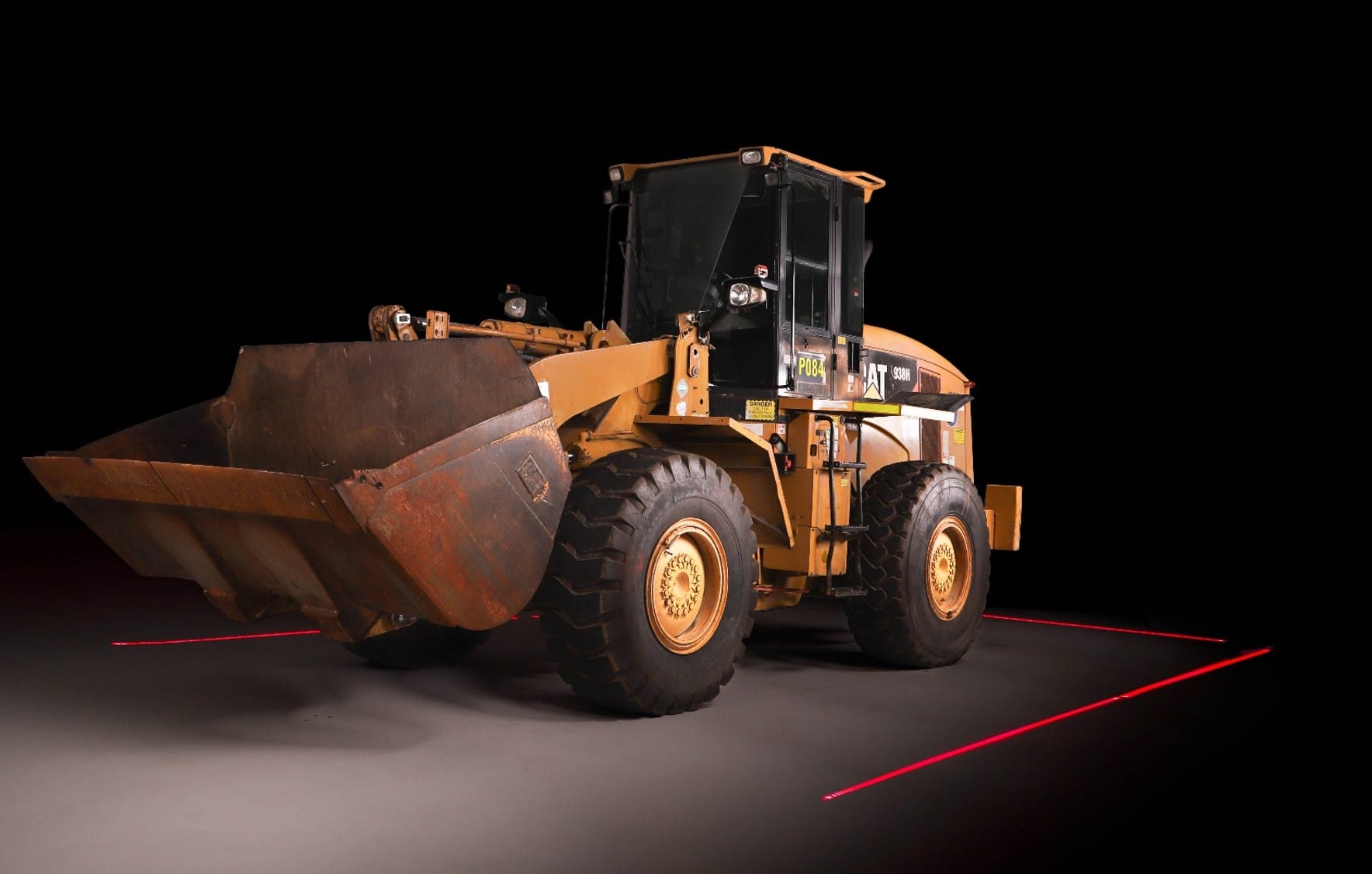
The interaction between pedestrians and heavy machinery is consistently one of the leading causes of fatalities in the mining industry worldwide. According to data from international mining safety organizations, incidents involving contact between people and moving equipment account for between 20% and 30% of deaths in open-pit operations. Despite safety protocols, traditional physical barriers such as cones, chains, and tape fail to effectively prevent these incidents — they shift, get forgotten, and cannot adapt to equipment movement.
How do you define a danger zone that keeps moving?
When an excavator, front-end loader, or forklift is in operation, the danger zone around it changes constantly. Static barriers cannot keep up with that movement. A cone marking a safety perimeter becomes useless the moment the machine advances three meters. LED vehicle identification helps know which equipment is moving, but does not define the risk zone. The result is a false sense of security that can have fatal consequences.
In Peruvian mining operations with equipment like CAT 793 trucks or hydraulic shovels, blind spots around machinery can extend several meters. A heavy equipment operator simply cannot see everything happening at ground level. And a worker on foot may not realize they are within the swing radius of a 200-ton machine.
Safety Halo: the exclusion zone that moves with the machine
Safety Halo, developed by Incident Zero (an Australian company specializing in industrial safety technology) and distributed in Peru by Endeavant, projects a high-intensity LED/laser line directly onto the ground around heavy equipment, creating a visual exclusion zone that travels with the machine. Anyone nearby can clearly see the danger zone boundary without any prior training.
There are no barriers to set up or remove. No cones to relocate. The exclusion zone is always active while the equipment operates. The projected line activates an instinctive self-preservation reflex: people naturally avoid stepping on or crossing a bright line on the ground. This psychological principle is what makes Safety Halo extraordinarily effective — it does not depend on the worker remembering a procedure, but on an automatic human reaction.
Three models for every type of equipment
- Halo Compact: designed for forklifts, skid steers, and compact warehouse or workshop equipment. Projection adjusted to the equipment's operating radius, ideal for confined spaces where proximity between people and machines is unavoidable. Perfect for spare parts warehouses, heavy equipment maintenance shops, and storage areas in mining operations.
- Halo Standard: for front-end loaders, excavators, backhoes, and medium equipment. Greater projection distance and brightness for open environments with dust and mixed traffic of people and vehicles. The most versatile model in the line, suitable for construction sites, processing plants, and loading/unloading zones.
- Halo HD: the version specifically designed for large-scale mining machinery: haul trucks, giant shovels, draglines, and drill rigs. Long-range projection visible even in the harshest conditions of dust, vibration, and low visibility typical of open-pit operations. Light intensity is calibrated to be visible in full daylight in desert environments.
Advantages that transform safety
- Visible in any condition: the projected line is visible during the day, at night, in dust, rain, and low-light conditions. The LED/laser technology maintains its intensity even in the most hostile environments of Peruvian mining.
- No additional infrastructure: mounts directly on the equipment and operates autonomously using the vehicle's own power supply. Completely eliminates the logistics of cones, chains, and temporary signage that consume time and resources.
- Adjustable projection distance: configured according to the equipment type and the danger radius required by the operation. Can be adapted to different working conditions without reinstallation.
- Immediate comprehension — no training needed: anyone — including visitors, new contractors, or personnel who don't speak the local language — instinctively understands they should not cross the illuminated line. The self-preservation reflex is universal.
- Extreme industrial-grade durability: built to withstand extreme vibration, abrasive dust, moisture, extreme temperatures, and the most demanding mining conditions. No moving parts or fragile exposed components.
- Compatible with audible alarms: can be combined with audible warning systems to reinforce the alert in high-noise environments where visibility can be complemented with audio signals.
Why is the pedestrian-machine risk the most critical?
Global mining safety statistics are conclusive: the interaction between people and moving equipment is consistently one of the top three causes of fatalities in the industry. In open-pit operations, where 400-ton trucks coexist with maintenance personnel, supervisors, and contractors, the risk is permanent. A haul truck has blind spots that can hide an entire light vehicle — let alone a person on foot.
Safety Halo addresses this risk head-on by creating a dynamic visual barrier that accompanies the equipment at all times, making visible what previously depended on manual procedures and individual discipline. Complemented with intelligent DMS/ADAS cameras that monitor the operator and their surroundings, this enables a comprehensive safety approach. For operations looking to raise their standards, it represents a qualitative leap in managing mining's most critical risk.
Industries and applications
Although Safety Halo was born for mining, its application extends to any environment where people and machines share space:
- Open-pit mining: haul trucks, shovels, loaders, drill rigs, draglines. The primary and most demanding application.
- Underground mining: scoops, jumbos, and transport equipment in confined spaces where visibility is limited.
- Warehousing and logistics: forklifts in distribution centers, spare parts warehouses, and loading/unloading zones.
- Construction: excavators, cranes, backhoes, and equipment operating in close proximity to construction personnel.
- Industrial plants: mixed-traffic zones where industrial vehicles and personnel coexist in shared spaces.
Available in Peru through Endeavant
Endeavant distributes the full Safety Halo line in Peru, with technical advisory to evaluate which model best fits each piece of equipment and operation. The process includes equipment fleet assessment, appropriate model recommendation (Compact, Standard, or HD), installation, and projection distance configuration. From forklifts in workshops to giant shovels in open pits, Safety Halo offers a proven solution, manufactured in Australia and locally backed by Endeavant, for the mining industry's most serious risk.