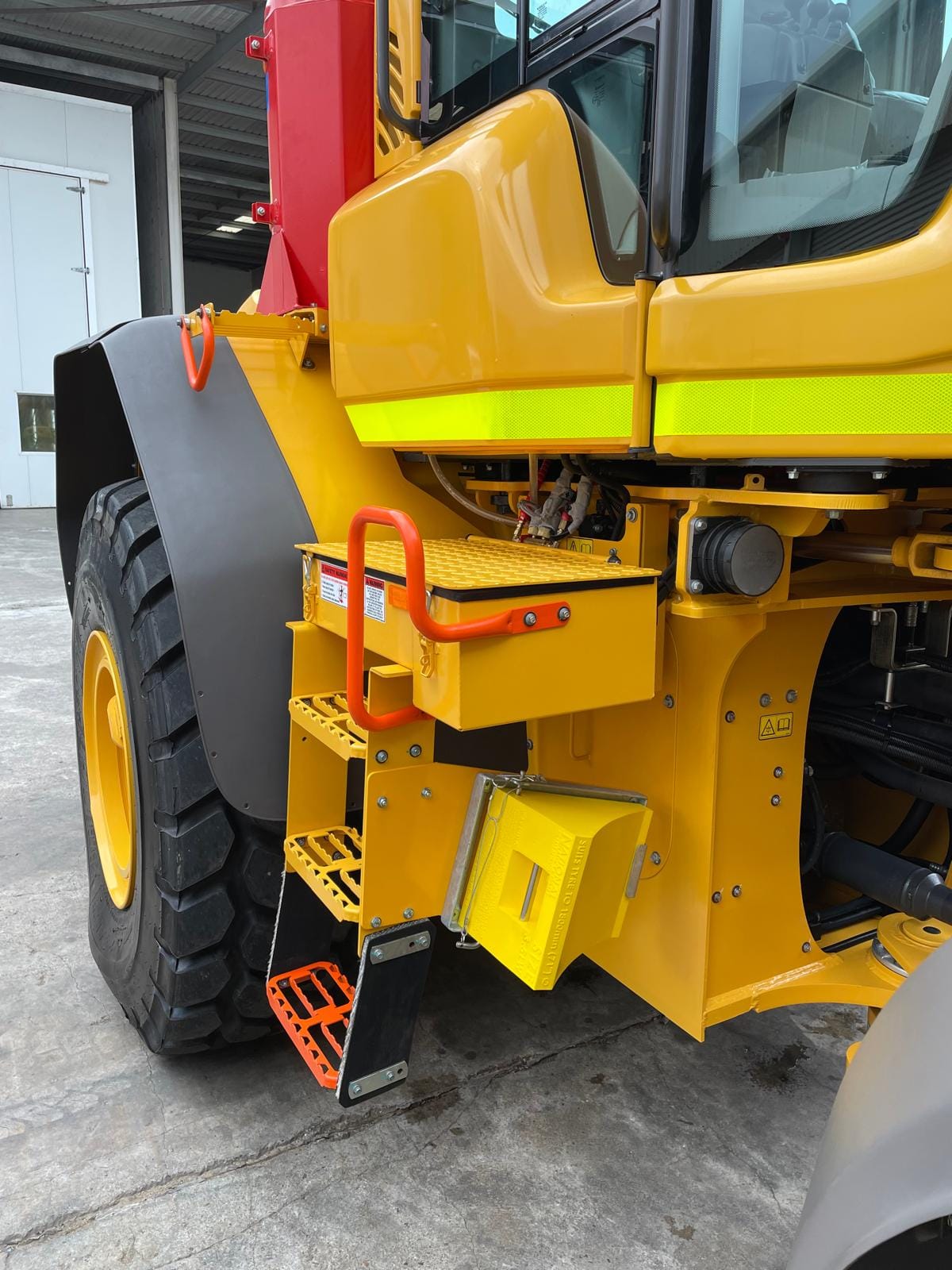
In mining operations, wheel chocking is not optional — it is a regulatory requirement and a critical measure to prevent accidents caused by unexpected vehicle movement. Regulations such as MSHA (Mine Safety and Health Administration) in the United States and ISRS (International Safety Rating System) standards require formal chocking procedures every time a vehicle is parked on a slope or during maintenance operations. In Peru, OSINERGMIN establishes similar requirements. Yet many operations still rely on steel, concrete, or wooden chocks — materials with the same structural limitations that affect traditional support blocks — presenting serious issues in weight, handling, tire protection, and safety traceability.
MineChock: Australian engineering in virgin polyurethane
MineChock is the wheel chock line manufactured by National Plastics & Rubber (NPR) in Australia, distributed in Peru by Endeavant. Unlike conventional steel, concrete, or rubber chocks, MineChock products are made from virgin high-density polyurethane — not rubber, not recycled plastic. This distinction is critical: virgin polyurethane guarantees batch-to-batch consistency in mechanical properties, superior impact resistance, and a significantly longer service life than recycled materials or conventional rubber.
Each model features a certified load rating and one-piece construction (no joints, welds, or components that can separate), allowing operations to select the exact chock for each vehicle type with complete confidence.
What chock range covers everything from light vehicles to the largest haul trucks in the world?
The Lightweight (LW) series spans 10 sizes covering an entire mining fleet, from pickups to the largest haul trucks in existence:
- Size 1.5LW (NPR01895-00): tires 400-800mm, 180x115x110mm, only 0.7 kg. For light and utility mine vehicles.
- Size 2LW (NPR01180-00): tires 400-900mm, 210x200x150mm, 1.6 kg. Pickups and supervision vehicles.
- Size 3LW (NPR01181-00): tires 900-1400mm, 340x220x200mm, 3.5 kg. Buses and medium mine trucks.
- Size 3.5LW (NPR02097-00): tires 1200-1800mm, 340x250x225mm, 6.2 kg. Service trucks and auxiliary equipment.
- Size 3.7LW (NPR01891-00): tires 1200-2200mm, 475x305x255mm, 6 kg. Graders and water trucks.
- Size 4LW (NPR01329-00): tires 1800-3000mm, 570x340x280mm, 9 kg. Medium haul trucks such as CAT 777 and Komatsu HD785.
- Size 5LW (NPR02155-00): tires 2200-3500mm, 621x343x323mm, 11 kg. CAT 785, 789, and Komatsu equivalents.
- Size 6LW (NPR00984-00): tires 2800-4200mm, 680x337x355mm, 14 kg. CAT 793, Komatsu 830E, Hitachi EH3500.
- Size 7LW (NPR05024-00): tires 2800-4500mm, 445x385x400mm, 16 kg. The world's largest trucks: CAT 797, Komatsu 980E, Hitachi EH4000, Liebherr T282.
- Size 4/3LW (NPR01476-00): tires 2800-4500mm, 559x330x280mm, 8 kg. Compact alternative version for large equipment.
All models are available with vehicle-mounted brackets for storage when not in use, and several models offer versions with Spanish-language identification plates.
Workshop Wheel Chock: ergonomic workshop chock
In addition to the LW field series, NPR offers the MineChock Workshop Wheel Chock, an ergonomic workshop chock that won the Innovation & People's Choice Award at the 2022 QLD Mining Health & Safety Conference. Available in two versions:
- Standard Workshop Chock (NPR07999-10) — 34 kg: for standard haul trucks. Its handle design allows placement and removal without the operator needing to go under the wheel, drastically reducing the risk of lower back injuries from repetitive bending.
- Workshop Chock Size 4 (NPR08304-10) — 21 kg: for equipment with smaller tires such as graders and small trucks.
Why is polyurethane superior to steel, concrete, and rubber?
- Up to 60% lighter than steel: a steel chock for a CAT 793 can weigh over 35 kg. The polyurethane Size 6LW weighs only 14 kg. This difference reduces physical strain on operators and the risk of musculoskeletal injuries — a frequent cause of lost-time incidents in mining.
- Tire-friendly: mining truck tires can cost between USD 30,000 and USD 70,000 each. Steel and concrete create concentrated pressure points that accelerate wear and can produce cuts. Polyurethane distributes the load without damaging the tire surface.
- High-visibility yellow color: all MineChock products are bright yellow, complying with mine signage best practices. A black rubber or gray concrete chock can be invisible in dusty or low-light conditions. Yellow ensures immediate visual identification.
- Total environmental resistance: polyurethane does not absorb water (unlike timber), does not rust (unlike steel), does not crack on impact (unlike concrete), and resists UV rays, oils, fuels, and chemicals commonly found in mining environments.
- Durability and consistency: does not rust, does not crack from thermal cycling, and maintains its mechanical properties over years of use. Unlike rubber, which hardens and loses elasticity with UV exposure, virgin polyurethane maintains its performance.
Regulatory compliance and safety culture
Mining safety regulations — both MSHA internationally and OSINERGMIN standards in Peru — require wheel chocking as a standard procedure. ISRS (International Safety Rating System) frameworks, widely adopted by major mining companies, specifically evaluate the quality and certification of chocking equipment. Using chocks without documented load capacity exposes the operation to legal risks, audit non-conformities, and most importantly, risks to personnel safety.
MineChock provides verifiable technical backing: each model has a documented load capacity, controlled dimensions, and a quality-controlled manufacturing process. This simplifies HSE audits, demonstrates a tangible commitment to worker protection, and generates documentary evidence for regulatory compliance.
The professional choice for mining operations in Peru
Endeavant distributes the full MineChock line in Peru — all 10 LW sizes, workshop chocks, and all mounting brackets — with technical advisory to select the right model based on vehicle type, tire size, and operating conditions. Together with Stacko™ support systems, standardizing wheel chocking across the entire fleet with a single certified polyurethane system is a decision that protects personnel, assets (tires included), and operational continuity.